Excerpted from Howard Phillips Issues and Strategy
Bulletin September 30, 2007
“No wonder Mexican presidents are coming
out of the closet about what is up. They know the
gringos can’t stop it, for they have the American
establishment on their side.” Source: Patrick
Buchanan, WorldNetDaily.com, 9/6/07
Excerpted from Howard Phillips Issues and Strategy
Bulletin #813, September 15, 2007
Excerpted from Howard Phillips Issues and Strategy
Bulletin #813, August 31, 2007
NAFTA SUPERHIGHWAY IS A REALITY
SUPRA-NATIONAL OVERSIGHT INSTITUTIONS ARE OPENLY PLANNED
VIRGIL GOODE’S HOUSE CONCURRENT RESOLUTION 40 MERITS SUPPORT
“Congress has thus far ignored its responsibility to
exercise Constitutional authority in this matter, as
it unfortunately has shirked its responsibilities in
so many other matters. Fortunately, Congressman
Virgil Goode (R-VA) has introduced a resolution, H.
Con. Res. 40, to remedy this problem. This
resolution, of which I am an original co-sponsor,
urges the United States not to engage in the
construction of the NAFTA Superhighway System,
disapproves of SPP plans to implement regulations
that would create a North American Union with Mexico
and Canada, calls on the President to oppose any
such proposals that threaten U.S. sovereignty. We
must demand that American sovereignty be
protected!” Source: Statement of Congressman Ron
Paul, M.D. (R-Tex.), for presentation at
August 20, 2007 TCC-hosted
Coalition to
Block the North American Union press
conference in Ottawa, Ontario, Canada
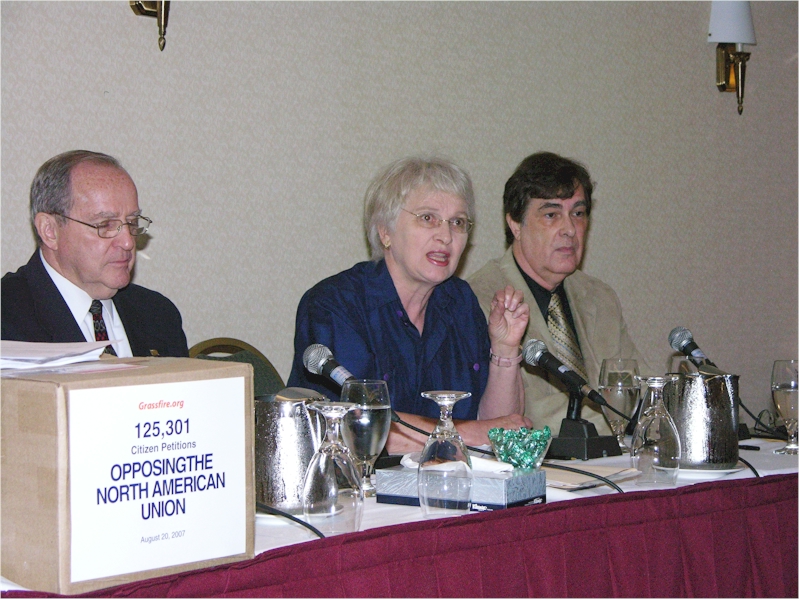
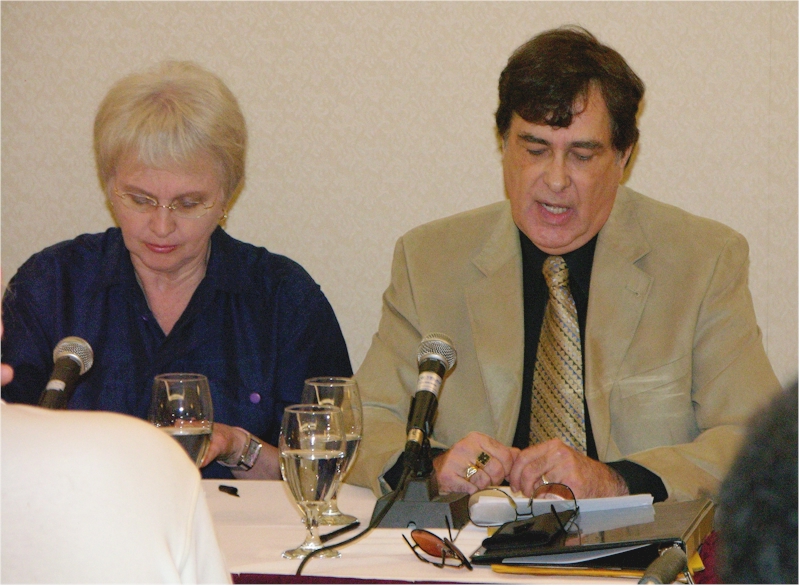
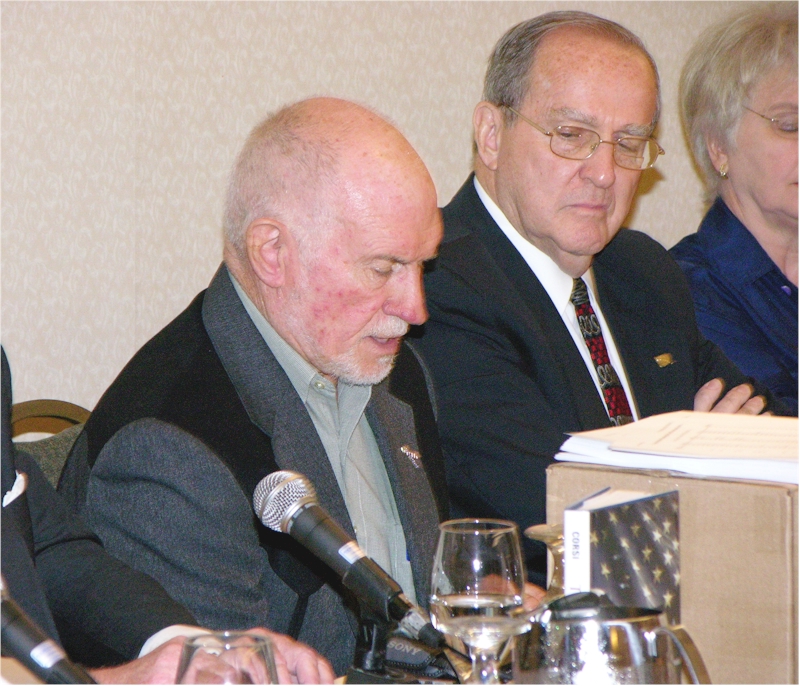
In my August 20 remarks as Chairman of
the Coalition
to Block the North American Union, I had this
to say at a well covered news conference at the
Marriott Ottawa hotel: “Recently, the supposed fiftieth anniversary of the
European Union (EU) was celebrated. But 50 years
ago there was no European Union. The EU was launched with the
formation of the European Iron and Coal Community.
Culminating step-by-step in the Maastricht Treaty,
approved in 1993, the European Union came into
being.
“That Union has now, with capitals in Strasbourg,
Luxembourg, and Brussels, achieved significant
dominance – judicially and legislatively – over what
was once the authority of the national governments
now part of the European Union.
“In 1993, I led a delegation of some two dozen
Americans to visit eight of the countries which were
considering approval of the Maastricht Treaty.
During our visit to Luxembourg, that country’s
Foreign Minister addressed us, unaware of our
skepticism concerning the Maastricht agreement. He
confided to us that, if the people of his country
had any idea of what was planned for them, they
would rise up in protest. But the plans of the
governing elites were kept secret from the people
and, incrementally, those New World Order elites
achieved their goal of a European Union.
“In similar fashion, behind closed doors,
step-by-step, the leaders of Mexico, Canada, and the
United States are setting the stage for, first, a
North American Community and, ultimately, a North
American Union (NAU), in which new transnational
bodies would gain authority over our economy, our
judiciary, and our lawmaking institutions.”
ECONOMIC INTEGRATION AND A NORTH AMERICAN BOUNDARY PERIMETER
“Advocates of the Security and Prosperity
Partnership (SPP) acknowledge that economic
integration is their objective, and that they favor
the eventual establishment of a border around the
perimeters of Canada and Mexico, with no border
control separating the United States and Mexico, or
the United States and Canada.
“In Europe today, citizens of the 27 constituent
states of the European Union can travel virtually at
will from country to country. Border control has
been surrendered. Each person who enters one EU
country is free to travel through any and all of the
others with virtually no restrictions.
“That is what the elites of the United States,
Canada, and Mexico have in mind for us. That helps
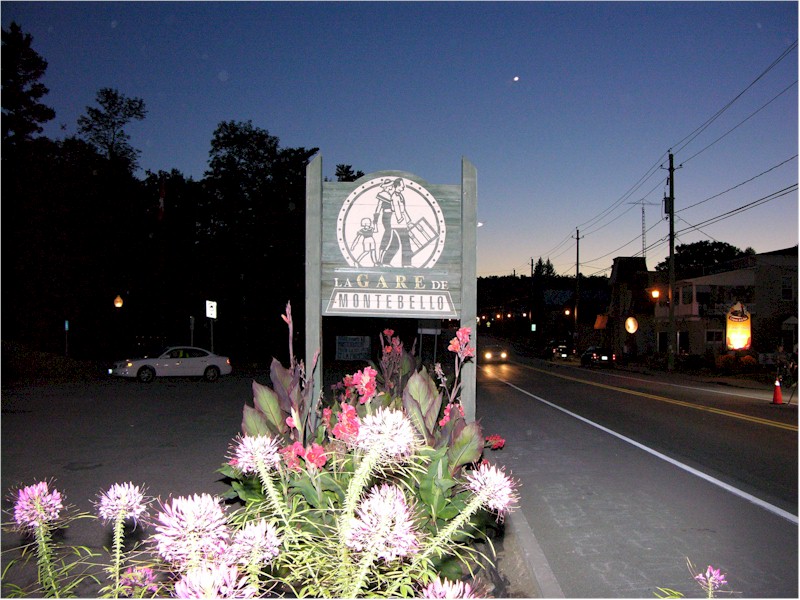
explain why the Montebello meeting is being held
behind closed doors, with little access to SPP
deliberations by the general public or even by the
media and elected politicians from the three
countries.
“That is why the
Coalition to
Block the North American Union of which I am
Chairman is conducting this news conference. Our
message to Messrs. Bush, Harper, and Calderon is
similar to the one which Ronald Reagan delivered to
Mikhail Gorbachev when he said ‘Mr. Gorbachev, tear
down that wall.’
“Our message is ‘President Bush, President Calderon,
Prime Minister Harper, tear down the wall of silence
and let the people see what you are scheming to do.’
” Source: Statement of Howard Phillips, at August
20, 2007 Coalition to Block the North American Union press conference
he hosted in Ottawa, Ontario, Canada
MONTEBELLO SPP CONFERENCE MOVES BEHIND CLOSED DOORS TO
INCREMENTALLY INTEGRATE U.S., CANADA, AND MEXICO IN
A NORTH AMERICAN UNION – WITHOUT AUTHORIZATION OR
OVERSIGHT BY U.S. CONGRESS
The conference dealt with the Security and
Prosperity Partnership (SPP) and the North American
Union (NAU). The only speaker who made the case
against the integration of North America
(undermining the status of America as an independent
Constitutional republic) was Dr. John Fonte.
Other speakers included Dr. Barbara Kotschwar of the
Peterson Institute for International Economics, Dr.
Robert Pastor of American University, Daniel
Schwanen of the Centre for International Governance
and Innovation, Sidney Weintraub of the Center for
Strategic and International Studies, Jaime Daremblum
of the Hudson Institute (HI), former Democrat
Congressman James R. Jones, Greg Anderson of the
University of Alberta, Christopher Sands of the HI,
and Ken Weinstein of the HI.
ECONOMIC INTEGRATION IS A KEY GOAL
In a paper entitled “Negotiating North America: The
Security and Prosperity Partnership”, Professor
Anderson and Mr. Sands made some of the following
points: “The SPP process is the vehicle for the
discussion of future arrangements for economic
integration to create a single market for goods
and services in North America…. The design of the
SPP is innovative, eschewing the more traditional
diplomatic and trade negotiation models in favor of
talks among civil service professionals and subject
matter experts within each government. This design
places the negotiation fully within the authority of
the executive branch in the United States….”
DECISION-MAKING BY TECHNOCRATS UNDERCUTS CONSTITUTIONAL ACCOUNTABILITY
“The SPP is the successor to two previous efforts
that had stalled or expired prior to 2005. First, a
set of trilateral working groups established in the
NAFTA to look at harmonizing standards and
eliminating differences in regulation…. The design
of the SPP is creative in handling asymmetry by
attempting a less political, technocratic
negotiation process; however, this has raised issues
of transparency and accountability that threaten the
future of the SPP process”.
SECRECY IS DESIGNED TO EXCLUDE POPULAR OPPOSITION
The authors acknowledge that “the process must be
made more transparent to answer legitimate citizen
concerns about potential outcomes.” They go on to
admit that “The design of the SPP is flawed by
the exclusion of Congress from the process.”
“POLITICIZATION” IS GOOD – CONTROL BY UNACCOUNTABLE BUREAUCRATS IS BAD
The authors oppose politicization (which is another
word for accountability to American citizens) saying
“The design of the SPP made it difficult to include
special interest input without politicizing the
negotiations. … the inclusion of some interest
groups and not others resulted in a further erosion
of confidence in the SPP process.”
MANIPULATION OF CONGRESS AND THE PEOPLE IS THE SPP STRATEGY
The authors observed that “The United States
[i.e. George W. Bush] faces three
important challenges in designing and conducting
negotiations under the SPP: managing the
asymmetry with smaller neighbors; managing Congress,
which has a constitutional role on trade and must be
persuaded to fund security measures; and the
[sic] managing the pressures from special
interests….”
U.S. SURRENDERS ITS ADVANTAGES
According to the authors, in order to persuade
Canada and Mexico to fully cooperate with the Bush
administration, it is important for the U.S. to
be “structuring negotiations in such a way that the
U.S. advantages are minimized, treating
negotiators for Canada and Mexico as equals and
partners and avoiding any explicit resort to its
advantages of size. … The United States has tried to
overcome the defensive instincts of its neighbors by
structuring negotiations in such a way that the U.S.
advantages are minimized…. Incentives for
cooperation rise in the presence of expectations
about benefits from future cooperation.” The
authors also admit that “In the context of North
America, and of deepening continental integration,
the management of Congressional relations presents
significant challenges for U.S. negotiators….”
AN INCREMENTAL MARCH TO THE NAU
Just as today’s European Union began 50 years ago
with the creation of the European Iron and Coal
Community, the Canada-U.S. Free Trade Agreement
negotiations in the 1980s were a first step on the
path toward a North American Union (NAU). These
were preceded by the Trade Act of 1974, which
created the Advisory Committee for Trade Policy and
Negotiations.
It is pointed out in the paper that “Perhaps the
most important feature of the SPP design is that it
is neither intended to produce a treaty nor an
executive agreement like the NAFTA that would
require congressional ratification or the passage of
implementing legislation in the United States.”
CONGRESSIONAL INVOLVEMENT COULD UNDERCUT CONTROL BY THE EXECUTIVE BRANCH
“The SPP was designed to function within existing
administrative authority of the executive branch.
Rules and standards could be set, law enforcement
and national security prerogatives pursued, all
within the broad parameters of constitutional
authority or prior congressional authorization. …
With presidential and cabinet-level political
support, the dozens of objectives outlined under
each of the 20 SPP working groups would proceed on
the basis of trilateral consultation at the
staff-level within respective government
agencies already responsible for those policy areas.
“Shifting the substantive work of the SPP to the
staff level, much as the NAFTA working groups
had done, would ostensibly depoliticize the
policy work being done by leaving it in the
hands of technical experts. Technocratic
negotiations would reduce the power-politics
dimension of the talks….”
It is asserted that “while shifting responsibility
for agenda items to the staff-level could
potentially de-politicize work on small issues, it
also effectively removed it from the kind of public
accountability normally associated with U.S. trade
negotiations.”
It is also observed in the paper that “Another
intervening factor that altered perceptions of the
SPP between Waco and Cancún came in May of 2005 when
the Council on Foreign Relations in the United
States released its Independent Task Force Report
No. 53, Building a North American Community.”
This report “recommended the establishment of a
customs union and common security perimeter by
2010.”
The authors point out that “The U.S. Congress has
no formal role in the SPP. As criticism of the
lack of transparency and public accountability of
the SPP negotiations has grown, congressional
interest and concern about the SPP has also grown.
There is now a handful of Members of Congress
(concentrated, for now, in the House of
Representatives) publicly opposed to proceeding with
the SPP, and determined to convene investigations
and oversight into the content of the talks.
Congressional hostility represents the biggest
threat to the continuation of the SPP after
Montebello, and after the end of the Bush
administration….”
WHITE HOUSE IS ON THE RECORD RE NAU GOALS
BUSH TACTICS ARE UNCONSTITUTIONAL
NAFTA IS A CONTINUING DISASTER
“When patriot Nathan Hale proclaimed, as he was
about to be executed by the British, ‘I regret that
I have but one life to give for my country’ – he
wasn't referring to Mexico. He certainly wasn’t
referring to Canada.
“No, he was willing and ready to die for the dream
called America, under a declaration of
independence from the purposes and perversions
of other nations. And like that hero, hundreds of
thousands of other Americans have given their lives
to preserve that dream, that vision of liberty,
equality and independence.
“Although we as a people have always
rushed to help our neighbors in their times of
trouble, and even sent our young men and women to
help those who had been our enemies – our
motivation, our character, our very DNA, has been
our independence. We’ve stayed fiercely free
to make our own judgments, our own policies, our own
determinations about what’s needful for America –
and what we should and shouldn’t do about the
concerns of others.
“And now we’re faced – threatened – with
the prospect of being lumped in with other countries
and all their problems, their different motivations
and philosophies, their corruptions and
controversies, and with the attendant necessity to
dilute or outright surrender our own best
interests. And the most horrible aspect of this
appears to be the willing compliance of our elected
leaders, all of whom have sworn to defend our
interests, not dissolve them.”
CONGRESSIONAL DELIBERATIONS HAVE NOT OCCURRED
“No matter the motivation or good
intentions of these public servants, our
Constitution demands that Congress be consulted to
‘advise and consent’. As far as any of us can tell,
this hasn’t been done, tho the plans for a North
American Union are well under way.”
WE THE PEOPLE MUST ACT
“Friends, we are the militia of
today, the citizen soldiers who must pick up our
Media Muskets, and come to the aid of our country.
We wish our neighbors no harm, but their problems
are for them to solve, as ours are for us. And
that’s the way it should be.
“May we be emulators of Nathan Hale, but hopefully
having to say only ‘We regret that we have only one
life to live ..for our country’.” Source:
Statement by Pat Boone on August 20, 2007 for the
Coalition to
Block the North American Union, released in
Ottawa, Ontario, Canada
“… [T]hanks to Freedom of Information
Act requests doggedly pursued by Judicial Watch, we
know there are some two-dozen trilateral ‘working
groups’ whittling away our sovereignty – er,
‘harmonizing’ our rules and regulations on
immigration, the environment, and health care with
those of Mexico and Canada. This effort, as one
of the SPP’s admirers has put it, involves the
nation-state’s ‘erosion by stealth.’ ” Source:
Frank Gaffney Jr. (president of the Center for
Security Policy), The Washington Times,
8/21/07, p. A12
Excerpted from Howard Phillips Issues and Strategy
Bulletin #813, August 15, 2007
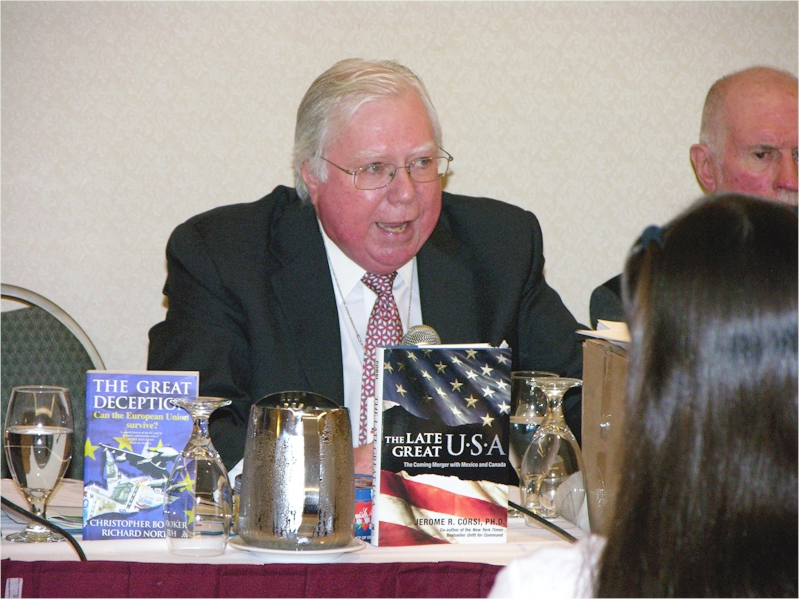
“Activists already are preparing to protest the
third summit meeting of the Security and Prosperity
Partnership of North America, a trilateral
initiative between the U.S., Canada and Mexico seen
by critics as a major step toward a North American
Union, according to WND columnist Jerome
Corsi, author of a new book on the subject, ‘The
Late Great USA.’ ”
“The meeting, which has received almost no mention
in the U.S. mainstream media, is scheduled for Aug.
20 and 21 in Montebello, Quebec, at the Fairmont Le
Chateau Montebello resort. Canadian Prime
Minister Stephen Harper is scheduled to host the
Quebec summit, which will be attended by Mexican
President Felipe Calderon and President Bush.
“Harper said in a statement announcing the SPP
summit, ‘We share a continent with the United States
and Mexico, and our people, our economies and our
security are closely interconnected.’
“The first SPP summit was held in Waco, Texas, March
23, 2005. The second … was held in Cancun, Mexico,
in March 2006.”
“Canadian groups that say they oppose the SPP agenda
of North American ‘deep integration’ are organizing
to protest the meeting.
“The Council of Canadians held a March 30-April 1
‘teach in’ titled ‘Integrate This! Challenging the
Security and Prosperity Partnership of North
America.’ A brochure on the Council of Canadians
website says SPP ‘is moving Canada quickly
toward a continental resource pact, a North American
security perimeter and harmonized military and
security policies.’ ”
“The brochure argues SPP working groups ‘composed of
bureaucrats and corporate leaders are quietly
putting this “partnership” into action, and to date
only industry “stakeholders” have been consulted.’
“WND reported the Canadian Action Party
flew the Canadian flag upside down during its 2006
convention as a sign of distress and resistance of
any integration into a North American regional
government.”
“WND also reported Canadian activists have
protested ‘The North American Future 2025 Project’
undertaken by the Center for Strategic and
International Studies, a Washington-based think tank
that plans to present its research results to the
U.S. Congress and the Canadian Parliament before the
end of the year.
“Canadian activists have argued a major goal of the
CSIS study is to identify Canadian oil and fresh
water as continental ‘North American natural
resources’ which, under SPP, could be diverted to
U.S. cities without fair compensation to Canada.”
Source:
www.WorldNetDaily.com, 6/20/07
“Speaking to the
California Republican Assembly (CRA) on
April 21, Royce, the Ranking Member of the House
Subcommittee on Terrorism, Nonproliferation and
Trade, warned the audience that the Bush
Administration is failing to protect U.S. borders
not only from entry by illegal aliens but from
potential terrorists. He disclosed that Bush has
complained to congressional Republicans that some of
his friends are not happy with the building of a
border fence between the U.S. and Mexico. But the
building of such a barrier is the law, Royce
emphasized.
“Delivering a wide-ranging attack on the Bush-backed
amnesty scheme, Royce said that one of the laughable
‘enforcement’ provisions of the bill requires
that illegal aliens caught in the U.S. be provided
with individual and group counseling, recreational
programs, special religious services, private toilet
and shower facilities, and clothes that are not
‘prison-style uniforms or jumpsuits.’ ”
“Under the bill, he continued, amnesty recipients
will receive Social Security benefits for their
illegal work, costing billions of dollars and
draining more money from the Social Security Trust
Fund. And once they become citizens and qualify
for welfare, Royce said the additional cost to
American taxpayers will be $30 billion per year. He
said the bill even allows U.S. companies under
certain conditions to fire American workers and hire
foreigners.”
FLAKE,
GUTIERREZ SCHEME FACILITATES NEW GOV’T OF NORTH
AMERICA (NAU)
“Reading from a congressional analysis of the bill,
H.R. 1645, which is co-sponsored by Rep.
Luis V. Gutierrez, a Democrat, and Rep. Jeff Flake,
a Republican, Royce said not only does it propose
‘mass amnesty’ for illegals but sets out an
‘immigration security strategy for North America’
and ‘a common security perimeter’ for the U.S.,
Canada and Mexico. Such terms suggest creation of a
North American Union.
"Pastor was asked what North American leaders would need to do to move
toward integration. ‘We need to form a customs union to move North American
integration to a new level,’ Pastor argued. ‘A customs union would eliminate
rules of origin on the border and agree to a common external tariff. This
would not be easy but not as difficult as NAFTA was, and it would lead to
efficiencies in our economies and in the end contribute to a better standard
of living for all parties.’
"Pastor also called for a North American Investment Fund to invest in
Mexico’s infrastructure.
" ‘If we had a North American Investment Fund,’ Pastor explained, ‘over
the long term, you would narrow the income gap between Mexico and the U.S.’
"WND previously reported Sen. John Cornyn, R-Texas, dropped his
support for legislation (S. 3622) he introduced in the 109th Congress to
create a North American Investment Fund after WND pointed out the
proposed law would advance an important part of Pastor’s agenda to create a
North American Community. …
"The idea seems to be to put new structures in place that change the look
of the landscape. WND pointed out to Pastor that this step-by-step
approach is the same approach taken to create the European Union. The
memoirs of Jean Monnet, regarded as the architect of European unity, finally
disclosed he had used a strategy of deceit, knowing his plan to form a
European Union would never succeed if it were openly disclosed." Source:
Jerome Corsi, WorldNetDaily.com, 12/15/06
Excerpted from Howard Phillips Issues and Strategy
Bulletin #791, June 15, 2006
THERE’S NO WALL TO PROTECT AMERICA FROM BUSH’S NAFTA
SUPER-HIGHWAY
"The Texas segment of the NAFTA Super Corridor is moving rapidly toward
approval. When built, the Trans-Texas Corridor, or TTC, will be a major
super-highway with six lanes moving in each direction, twelve lanes across
in total, described in the 4,000 page draft environmental study as including
separate lanes ‘for passenger vehicles and large trucks, freight railways,
high-speed commuter railways, and a corridor for utilities including water
lines, oil and natural gas pipelines, and transmission lines for
electricity, broadband and other telecommunications services.’ …
"The idea is to extend the rebuilt I-35 NAFTA super-corridor highway
all the way from Laredo, Texas, to Canada, with extensions in Canada to
be built out to Montreal in the east and Vancouver in the west. In Mexico,
the super-corridor will connect via Mexican railroads with the port at
Lazaro Cardenas."
A BIG BOOST FOR CHICOM IMPORTS
"A core design feature is to create a hub in Kansas City. Here the
‘Lazaro Cardenas – Kansas City Transportation Corridor’ will open up a
north-south route through the United States to bring in containers from the
Far East. As described by Kansas City’s Smart Port website: The Lazaro
Cardenas – Kansas City Corridor refers to a trade route linking Kansas City
to key Asia-Pacific Markets via a ships-to-rail terminal at the port of
Lazaro Cardenas in the State of Michoacan, Mexico. Thanks to an
innovative series of international agreements, infrastructure improvements
and new technologies, this corridor is a reality. …"
FOREIGN CHEAP LABOR PRODUCTS FOR U.S. CONSUMPTION
"The NAFTA Super Corridor plan is ultimately to reduce the
transportation costs of using cheap labor in China, South Korea and
Indonesia to produce goods for American markets. Bypassing West Coast
ports in the U.S. means bypassing U.S. union wages. Mexican port and rail
transport are expected to keep the shipping costs low. Also, allowing free
access to the U.S. [by] Mexican trucks means that the containers can be
moved through the U.S. by Mexican nationals, again bypassing Teamster union
wages and benefits typically paid U.S. truck drivers."
PANAMA CANAL CIRCUMVENTED
"To get a feel for how transportation planners are influenced by
globalist economic thinking, consider this 2005 analysis written by Leonard
Krouner in the Voice of San Diego: The Los Angeles/Long Beach and
Seattle/Tacoma harbors are the only two West Coast ports between Alaska and
Chile that can be used by super-cargo ‘post-Panamax’ ships with a 4,000
standardized cargo container capacity. The ability to off-load, move,
unload, store and distribute cargo from these ships requires expansion of
California’s transportation infrastructure. Delays increasing costs for
cargo movement at the Los Angeles/Long Beach port such as those extant
during the 2003 longshoreman labor unrest, and the 2004 arrival of too many
ships in a single time period with cargo for distribution prior to the
Christmas holidays are motivating mega importers Wal-Mart and Home Depot to
invest in warehouse facilities in less expensive states such as Georgia."
NORTH AMERICAN UNION OF U.S.-MEXICO-CANADA BYPASSES
CONGRESS AND THE CONSTITUTION
"None of this would be possible without the extensive work being done
by the U.S. Department of Commerce working groups charged with implementing
by new regulations the Strategic and Prosperity Partnership of North America,
or SPP. The SPP agreement was reached between President Bush, President
Vicente Fox and Canadian Prime Minister Paul Martin during their March 2005
summit meeting in Waco, Texas. The Bush administration plan is to create
a North American Union along the model of the European Union, put in place
by administrative regulations and departmental working groups under the SPP
umbrella."
COMMERCE AND TRANSPORTATION DEPARTMENTS DIRECTED TO GIVE
MEXICO FREEDOM FROM INSPECTION
"The U.S. Department of Transportation is actively working on a Free
and Secure Trade program that would create special lanes to allow trucks
from Mexico to cross the U.S. border with minimal electronic inspection,
reducing the U.S. border with Mexico to no more than a speed-bump for
authorized Mexican trucks entering the country."
SCOTUS AIDED BUSH’S NAFTA SCHEME
"On June7, 2004, the U.S. Supreme Court in the case Department of
Transportation v. Public Citizen ruled in favor of the Bush
administration’s argument that the Federal Motor Carrier Safety
Administration lacked the authority to exercise environmental controls to
prevent Mexican trucks from openly operating in the U.S. under NAFTA.
This ruling was key in the Bush administration’s determination to open U.S.
borders to Mexican trucks under the trade agreement. Had the Supreme
Court decided otherwise, the NAFTA Super Corridor project would have
suffered a setback."
TRILATERALISM HAS AN ADDITIONAL MEANING
"I continue to argue that a ‘follow the money’ strategy must be
utilized to understand why President Bush has refused to close our border
with Mexico, pushing instead for ‘comprehensive immigration reform’
legislation that would allow the vast majority of illegal immigrants now in
the U.S. to remain under a ‘guest worker’ or ‘pathway to citizenship’
provision. The underlying agenda of the Bush administration seems to be
to create a NAFTA-plus environment in which workers, trade and capital will
be allowed to flow unimpeded within the trilateral North American community
consisting of the United States, Canada and Mexico." Source: Dr. Jerome
Corsi, WorldNetDaily.com, 6/1/06
"Quietly but systematically, the Bush Administration is advancing the
plan to build a huge NAFTA Super Highway, four football-fields-wide, through
the heart of the U.S. along Interstate 35, from the Mexican border at
Laredo, Tex., to the Canadian border north of Duluth, Minn."
MEXICAN GOVERNMENT IN CHARGE OF INSPECTIONS
"Once complete, the new road will allow containers from the Far East to
enter the United States through the Mexican port of Lazaro Cardenas,
bypassing the Longshoreman’s Union in the process. The Mexican trucks,
without the involvement of the Teamsters Union, will drive on what will be
the nation’s most modern highway straight into the heart of America. The
Mexican trucks will cross border in FAST lanes, checked only electronically
by the new "SENTRI" system. The first customs stop will be a Mexican
customs office in Kansas City, their new Smart Port complex, a facility
being built for Mexico at a cost of $3 million to the U.S. taxpayers in
Kansas City. …"
NASCO FUNDED WITH YOUR TAXES
"NASCO, the North America SuperCorridor [sic] Coalition Inc., a
‘non-profit organization dedicated to developing the world’s first
international, integrated and secure, multi-modal transportation system
along the International Mid-Continent Trade and Transportation Corridor to
improve both the trade competitiveness and quality of life in North
America.’ Where does that sentence say anything about the USA? Still, NASCO
has received $2.5 million in earmarks from the U.S. Department of
Transportation to plan the NAFTA Super Highway as a 10-lane limited-access
road (five lanes in each direction) plus passenger and freight rail lines
running alongside pipelines laid for oil and natural gas. One glance at the
map of the NAFTA Super Highway on the front page of the NASCO website will
make clear that the design is to connect Mexico, Canada, and the U.S. into
one transportation system."
ENVIRONMENTAL IMPACT CONSIDERED – NOT CONSTITUTIONAL
IMPACT
"The Texas Department of Transportation (TxDOT) is overseeing the
Trans-Texas Corridor (TTC) as the first leg of the NAFTA Super Highway. A
4,000-page environmental impact statement has already been completed and
public hearings are scheduled for five weeks, beginning next month, in July
2006. The billions involved will be provided by a foreign company, Cintra
Concessions de Infraestructuras de Transporte, S.A. of Spain. As a
consequence, the TTC will be privately operated, leased to the Cintra
consortium to be operated as a toll-road."
WHY IS THIS SCHEME TO END U.S. AS WE KNOW IT NOT DEBATED
IN CONGRESS?
"The details of the NAFTA Super Highway are hidden in [plain] view.
Still, Bush has not given speeches to bring the NAFTA Super Highway plans to
the full attention of the American public. Missing in the move toward
creating a North American Union is the robust public debate that preceded
the decision to form the European Union. All this may be for calculated
political reasons on the part of the Bush Administration.
"A good reason Bush does not want to secure the border with Mexico may be
that the administration is trying to create express lanes for Mexican trucks
to bring containers with cheap Far East goods into the heart of the U.S.,
all without the involvement of any U.S. union workers on the docks or in the
trucks." Source: Jerome Corsi, Human Events ONLINE, 6/12/06
Excerpted from Howard Phillips Issues and Strategy
Bulletin #792, June 30, 2006
BUSH IS TREASONOUSLY MOVING TO SUBMERGE OUR INDEPENDENT
AMERICAN REPUBLIC IN A NORTH AMERICAN UNION
"In March 2005 at their summit meeting in Waco, Tex., President Bush,
President Fox and Prime Minister Martin issued a joint statement
[announcing] the creation of the ‘Security and Prosperity Partnership of
North America’ (SPP). The creation of this new agreement was never submitted
to Congress for debate and decision. Instead, the U.S. Department of
Commerce merely created a new division under the same title to implement
working groups to advance a North American Union working agenda in a wide
range of areas, including: manufactured goods, movement of goods, energy,
environment, e-commerce, financial services, business facilitation, food and
agriculture, transportation, and health.
"SPP is headed by three top cabinet level officers of each country.
Representing the United States are Secretary of Commerce Carlos Gutierrez,
Secretary of Homeland Security Michael Chertoff, and Secretary of State
Condoleezza Rice. Representing Mexico are Secretario de Economía Fernando
Canales, Secretario de Gobernación Carlos Abascal, and Secretario de
Relaciones Exteriores, Luis Ernesto Derbéz. Representing Canada are Minister
of Industry David L. Emerson, Deputy Prime Minister and Minister of Public
Safety, Anne McLellan, and Minister of Foreign Affairs Pierre Stewart
Pettigrew. …"
A SECRET COVENANT TO DESTROY THE U.S. CONSTITUTION
"Reviewing the specific working agenda initiatives, the goal to implement
directly is apparent. Nearly every work plan is characterized by action
steps described variously as ‘our three countries signed a Framework of
Common Principles …’ or ‘we have signed a Memorandum of Understanding …,’ or
‘we have signed a declaration of intent …’ etc. Once again, none of the 30
or so working agendas makes any mention of submitting decisions to the U.S.
Congress for review and approval. No new U.S. laws are contemplated for the
Bush administration to submit to Congress. Instead, the plan is obviously
to knit together the North American Union completely under the radar,
through a process of regulations and directives issued by various U.S.
government agencies.
"What we have here is an executive branch plan being implemented by the
Bush administration to construct a new super-regional structure completely
by fiat. Yet, we can find no single speech in which President Bush has ever
openly expressed to the American people his intention to create a North
American Union by evolving NAFTA into this NAFTA-Plus as a first,
implementing step."
BUSH WANTS OPEN BORDERS WITH CANADA AND MEXICO
"Anyone who has wondered why President Bush has not bothered to secure
our borders is advised to spend more time examining the SPP working groups’
agenda. In every area of activity, the SPP agenda stresses free and open
movement of people, trade, and capital within the North American Union.
Once the SPP agenda is implemented with appropriate departmental
regulations, there will be no area of immigration policy, trade rules,
environmental regulations, capital flows, public health, plus dozens of
other key policy areas countries that the U.S. government will be able to
decide alone, or without first consulting with some appropriate North
American Union regulatory body. At best, our border with Mexico will become
a speed bump, largely erased, with little remaining to restrict the
essentially free movement of people, trade, and capital."
MEXICO TELLS THE TRUTH
"Canada has established an SPP working group within their Foreign Affairs
department. Mexico has placed the SPP within the office of the [Secretario]
de Economia and created [an] extensive website for the Alianza Para La
Securidad y La Prosperidad de [América] del Norte (ASPAN). On this
Mexican website, ASPAN is described as ‘a permanent, tri-lateral process to
create a major integration of North America.’ "
THE CFR PLANNED IT TO TAKE EFFECT BY 2010
"The extensive working group activity being implemented right now by the
government of Mexico, Canada, and the United States is consistent with the
blueprint laid out in the May 2005 report of the Council on Foreign
Relations (CFR), titled ‘Building a North American Community.’
"The Task Force’s central recommendation is the establishment by
2010 of a North American economic and security community, the boundaries
of which would be defined by a common external tariff and an outer
security perimeter. (page xvii)
"The only borders or tariffs which would remain would be those around the
continent, not those between the countries within:
"Its (the North American Community’s) boundaries will be defined by a
common external tariff and an outer security perimeter within which the
movement of people, products, and capital will be legal, orderly, and
safe. Its goal will be to guarantee a free, secure, just, and prosperous
North America. (page 3)"
U.S. CITIZENSHIP TO BE SUBORDINATE TO TRILATERAL
BUREAUCRACY
"What will happen to the sovereignty of the United States? The model is
the European Community. While the United States would supposedly remain
as a country, many of our nation-state prerogatives would ultimately be
superseded by the authority of a North American court and parliamentary
body, just as the U.S. dollar would have to be surrendered for the ‘Amero,’
the envisioned surviving currency of the North American Union. The CFR
report left no doubt that the North American Union was intended to evolve
through a series of regulatory decisions:
"While each country must retain its right to impose and maintain
unique regulations consonant with its national priorities and income
level, the three countries should make a concerted effort to encourage
regulatory convergence.
"The three leaders highlighted the importance of addressing this
issue at their March 2005 summit in Texas. The Security and Prosperity
Partnership for North America they signed recognizes the need for a
stronger focus on building the economic strength of the continent in
addition to ensuring its security. To this end, it emphasizes regulatory
issues. Officials in all three countries have formed a series of working
groups under designated lead cabinet ministers. These working groups
have been ordered to produce an action plan for approval by the leaders
within ninety days, by late June 2005, and to report regularly
thereafter. (pages 23-24)"
A COUP D’ETAT, WHICH IS GROUNDS FOR IMPEACHMENT AND
REMOVAL FROM OFFICE
"Again, the CFR report says nothing about reporting to Congress or to the
American people. What we have underway here with the SPP could arguably be
termed a bureaucratic coup d’etat. If that is not the intent, then President
Bush should rein in the bureaucracy until the American people have been
fully informed of the true nature of our government’s desire to create a
North American Union. Otherwise, the North American Union will become a
reality in 2010 as planned. Right now, the only check or balance being
exercised is arguably Congressional oversight of the executive bureaucracy,
even though Congress itself might not fully appreciate what is happening."
Source: Jerome Corsi, Human Events, 5/30/06
Excerpted from Howard Phillips Issues and Strategy
Bulletin #794, July 31, 2006
BUSH COMMEMORATES FOUNDING OF SPPNA
"When President George W. Bush met the Mexican and Canadian heads of
state in Cancun, Mexico, in April 2006, he said the meeting celebrated the
first anniversary of the Security and Prosperity Partnership of North
America and was a follow-up to last year’s Summit in Waco, Texas. At
last year’s meeting on March 23, 2005 at Bush’s ranch and at Waco, George W.
Bush, Mexican President Vicente Fox, and Canadian Prime Minister Paul Martin
‘committed their governments’ to the ‘Security and Prosperity Partnership of
North America’ and assigned ‘working groups’ to fill in the details.
"A follow-up meeting was held in Ottawa on June 27, 2005 where the U.S.
representative, Homeland Security Secretary Michael Chertoff, told a news
conference that ‘we want to facilitate the flow of traffic across our
borders.’ The White House issued a statement that the Ottawa report
‘represents an important first step in achieving the goals of the Security
and Prosperity Partnership.’ "
CFR LAID OUT PLANS TO ABOLISH U.S. BORDERS WITH CANADA AND
MEXICO
"This plan was spelled out in detail in a Council on Foreign Relations
(CFR) 59-page document. It describes a five-year plan for the ‘establishment
by 2010 of a North American economic and security community’ with a common
‘outer security perimeter.’ ‘Community’ means creating ‘a common
economic space … for all people in the region, a space in which trade,
capital, and people flow freely.’ That means integrating the United States
with the corruption, socialism, poverty and population of Mexico and Canada.
‘Common perimeter’ means wide-open U.S. borders between the U.S., Mexico and
Canada."
EUROPEAN UNION IS THE MODEL
"The CFR plan calls for ‘a more open border for the movement of goods and
people’ and ‘the freer flow of people within North America.’ The ‘common
security perimeter’ will require us to ‘harmonize visa and asylum
regulations’ with Mexico and Canada, ‘harmonize entry screening,’ and ‘fully
share data about the exit and entry of foreign nationals.’
"This plan would create a ‘North American preference’ so that employers
can recruit low-paid workers from anywhere in North America. No longer
will illegal aliens have to be smuggled across the border; employers can
openly recruit foreigners willing to work for a fraction of U.S. wages.
Just to make sure that bringing cheap labor from Mexico is an essential part
of the plan, the CFR document calls for ‘a seamless North American market’
and for ‘the extension of full labor mobility to Mexico.’ "
BUSH LIES WHEN HE CLAIMS A DESIRE TO CONTROL OUR BORDERS
"Senator Richard Lugar held a friendly hearing before his Senate Foreign
Relations Committee at which American University Professor Robert A. Pastor
(a member of the CFR Task Force) testified that President Bush is a staunch
supporter of North American integration dating from the Guanajuato Proposal
which he and Vicente Fox signed in February 2001." Source: America’s
Future, Maj. Gen. John K. Singlaub, President, May/June 2006, p. 1
Excerpted from Howard Phillips Issues and Strategy
Bulletin #795, August 15, 2006
GWB WANTS TO ELIMINATE U.S. BORDERS BETWEEN MEXICO AND
CANADA
"The idea to form the North American Union as a super-NAFTA knitting
together Canada, the United States and Mexico into a super-regional
political and economic entity was a key agreement resulting from the March
2005 meeting held at Baylor University in Waco, Tex., between President
Bush, President Fox and Prime Minister Martin. A joint statement published
by the three presidents following their Baylor University summit announced
the formation of an initial entity called, ‘The Security and Prosperity
Partnership of North America’ (SPP). The joint statement termed the SPP a
‘trilateral partnership’ that was aimed at producing a North American
security plan as well as providing free market movement of people, capital,
and trade across the borders between the three NAFTA partners: We will
establish a common approach to security to protect North America from
external threats, prevent and respond to threats within North America, and
further streamline the secure and efficient movement of legitimate, low-risk
traffic across our borders."
CFR RECOMMENDS FULL IMPLEMENTATION OF SUPER-NAFTA BY 2010
"A working agenda was established: We will establish working parties led
by our ministers and secretaries that will consult with stakeholders in our
respective countries. These working parties will respond to the priorities
of our people and our businesses, and will set specific, measurable, and
achievable goals. The U.S. Department of Commerce has produced a SPP
website, which documents how the U.S. has implemented the SPP directive into
an extensive working agenda.
"Following the March 2005 meeting in Waco, Tex., the Council on
Foreign Relations (CFR) published in May 2005 a task force report titled
‘Building a North American Community.’ We have already documented that
this CFR task force report calls for a plan to create by 2010 a redefinition
of boundaries such that the primary immigration control will be around the
three countries of the North American Union, not between the three
countries. We have argued that a likely reason President Bush has not
secured our border with Mexico is that the administration is pushing for the
establishment of the North American Union."
NORTH AMERICAN UNION WOULD OVERRIDE U.S. CONSTITUTION
"The North American Union is envisioned to create a super-regional
political authority that could override the sovereignty of the United States
on immigration policy and trade issues. In his June 2005 testimony to the
U.S. Senate Foreign Relations Committee, Robert Pastor, the Director of the
Center for North American Studies at American University, stated clearly the
view that the North American Union would need a super-regional governance
board to make sure the United States does not dominate the proposed North
American Union once it is formed: NAFTA has failed to create a
partnership because North American governments have not changed the way they
deal with one another. Dual bilateralism, driven by U.S. power, [continues]
to govern and irritate. Adding a third party to bilateral disputes vastly
increases the chance that rules, not power, will resolve problems."
CONGRESS WOULD BE SUBORDINATE TO 15-MEMBER COMMISSION
"This trilateral approach should be institutionalized in a new North
American Advisory Council. Unlike the sprawling and intrusive European
Commission, the Commission or Council should be lean, independent, and
advisory, composed of 15 distinguished individuals, 5 from each nation. Its
principal purpose should be to prepare a North American agenda for leaders
to consider at biannual summits and to monitor the implementation of the
resulting agreements. Pastor was a vice chairman of the CFR task force that
produced the report ‘Building a North American Union.’ "
EVEN THE U.S. SUPREME COURT WOULD BE SIDELINED BY NAFTA
SUPER-COURT
"Pastor also proposed the creation of a Permanent Tribunal on Trade and
Investment with the view that ‘a permanent court would permit the
accumulation of precedent and lay the groundwork for North American business
law.’ The intent is [that] this North American Union Tribunal would have
supremacy over the U.S. Supreme Court on issues affecting the North American
Union, to prevent U.S. power from ‘irritating’ and retarding the progress of
uniting Canada, Mexico, and the U.S. into a new 21st century
super-regional governing body."
NAFTA SUPER-PARLIAMENT IS ENVISIONED
"Robert Pastor also advises the creation of a North American
Parliamentary Group to make sure the U.S. Congress does not impede progress
in the envisioned North American Union. He has also called for the creation
of a North American Customs and Immigration Service which would have
authority over U.S. Immigration and Customs Enforcement (ICE) within the
Department of Homeland Security."
LESSONS LEARNED FROM THE EUROPEAN UNION
"Pastor’s 2001 book ‘Toward a North American Community’ called for the
creation of a North American Union that would perfect the defects Pastor
believes limit the progress of the European Union. Much of Pastor’s thinking
appears aimed at limiting the power and sovereignty of the United States as
we enter this new super-regional entity."
"AMERO" WOULD REPLACE THE DOLLAR
"Pastor has also called for the creation of a new currency which he
has coined the ‘Amero,’ a currency that is proposed to replace the U.S.
dollar, the Canadian dollar, and the Mexico peso."
IF BUSH HAD REVEALED HIS PLAN TO PROMOTE THIS SCHEME,
HE WOULD HAVE BEEN DEFEATED
"If President Bush had run openly in 2004 on the proposition that a prime
objective of his second term was to form the North American Union and to
supplant the dollar with the ‘Amero,’ we doubt very much that President Bush
would have carried Ohio, let alone half of the Red State majority he needed
to win re-election. Pursuing any plan that would legalize the conservatively
estimated 12 million illegal aliens now in the United States could well
spell election disaster for the Republican Party in 2006, especially for the
House of [Representatives] where every seat is up for grabs." Source: Jerome
Corsi, (humaneventsonline.com), The Free Press, 6/16/06, p. 2
COLEMAN-CORNYN BILL (S. 3622) WOULD TAX YOU TO BUILD
MEXICO’S INFRA-STRUCTURE
"Sen. John Cornyn, R-Texas, has quietly introduced a bill to create a
‘North American Investment Fund’ that would tap U.S. and Canadian taxpayers
for the development of public works projects in Mexico.
"Despite assurances this week from White House press secretary Tony Snow
that President Bush opposes the idea of a European Union superstate for
North America, the effort, by one of the president’s loyal supporters in the
Senate, is sure to spark new questions about negotiations between the
leaders of Canada, the U.S. and Mexico on issues ranging from security to
the economy.
" ‘Currently, a significant development gap exists between Mexico and
the United States and Canada,’ Cornyn said. ‘I believe it is in our best
interests to find creative ways to bridge this development gap.’ …"
BUSH’S SUPER-NAFTA IS THE REASON
"Senate Bill 3622, co-sponsored by Sen. Norm Coleman, R-Minn.,
specifically authorizes the president to ‘negotiate the creation of a North
American Investment Fund between the governments of Canada, of Mexico, and
of the U.S. to increase the economic competitiveness of North America in a
global economy.’ …
" ‘The purpose of this fund is to reinforce efforts already underway in
Mexico to ensure their (sic) own economic development,’ Cornyn said. ‘The
funding would make grants available for projects to construct roads in
Mexico, to facilitate trade, to develop and expand their education programs,
to build infrastructure for the deployment of communications services and to
improve job training and workforce development for high-growth industries.’
…"
LOU DOBBS CRITICALLY REPORTS GWB SCHEME TO CREATE NORTH
AMERICAN UNION
"Lou Dobbs of CNN – a frequent critic of Bush’s immigration policies –
has been most outspoken. ‘A regional prosperity and security program?’ he
asked rhetorically in a recent cablecast. ‘This is absolute ignorance. And
the fact that we are – we reported this, we should point out, when it was
signed. But, as we watch this thing progress, these working groups are
continuing. They’re intensifying. What in the world are these people
thinking about? You know, I was asked the other day about whether or not I
really thought the American people had the stomach to stand up and stop this
nonsense, this direction from a group of elites, an absolute contravention
of our law, of our Constitution, every national value. And I hope, I pray
that I’m right when I said yes. But this is – I mean, this is beyond
belief.’ "
TANCREDO SPEAKS OUT
"Rep. Tom Tancredo, R-Colo., the chairman of the House Immigration Reform
Caucus as well as author of the new book, ‘In Mortal Danger,’ may be the
only elected official to challenge openly the plans for the new superstate.
Responding to a WorldNetDaily report, Tancredo is demanding the Bush
administration fully disclose the activities of the government office
implementing the trilateral agreement that has no authorization from
Congress.
"Tancredo wants to know the membership of the Security and Prosperity
Partnership groups along with their various trilateral memoranda of
understanding and other agreements reached with counterparts in Mexico and
Canada."
MINUTEMAN JIM GILCHRIST REBUKES GWB
"Jim Gilchrist, co-founder of the Minutemen, welcomed Tancredo’s efforts.
‘It’s time for the Bush administration to come clean,’ Gilchrist said.
‘If President Bush’s agenda is to establish a new North American union
government to supersede the sovereignty of the United States, then the
president has an obligation to tell this to the American people directly.
The American public has a right to know.’ "
U.S. CITIZENS ARE INTENTIONALLY BEING BLIND-SIDED
"Geri Word, who heads the SPP office, told WND the work had not
been disclosed because, ‘We did not want to get the contact people of the
working groups distracted by calls from the public.’ WND can find no
specific congressional legislation authorizing the SPP working groups nor
any congressional committees taking charge of oversight.
"Many SPP working groups appear to be working toward achieving specific
objectives as defined by a May 2005 Council on Foreign Relations task force
report, which presented a blueprint for expanding the SPP agreement into a
North American union that would merge the U.S., Canada and Mexico into a new
governmental form." Source: Joseph Farah, www.WorldNetDaily.com,
7/13/06
Excerpted from Howard Phillips Issues and Strategy
Bulletin #796, August 31, 2006
100 MEXICAN TRUCKING COMPANIES WILL SOON INVADE AMERICA
"Transportation Secretary Maria Cino promises to release plans within
months for a one-year, NAFTA pilot program permitting Mexican truckers
beyond the limited commercial zone to which they are currently restricted.
"The program will likely involve about 100 Mexican trucking companies,
the Department of Transportation says. …"
A SUPERHIGHWAY FOR ILLEGAL ALIENS
"Currently, the U.S. permits Mexican truckers only in commercial zones
close to the border that extend no further than 20 miles from Mexico.
"While the American Trucking Association supports opening the border,
other unions have joined in opposition with the Teamsters. The
Owner-Operator Independent Drivers Association came out this month in
opposition to any Mexican truck pilot program.
"Todd Spencer, the association's executive vice president, said the
program would jeopardize safety on U.S. roads and would lead to an influx of
cheap Mexican labor.
" ‘A move by the U.S. Department of Transportation to open U.S. roadways
to Mexican trucks puts the interest of foreign trade and cheap labor ahead
of everything else, including highway safety, homeland security and the well
being of hardworking Americans,’ Spencer said.
"In a letter to the Interstate Trade Commission, Spencer wrote: ‘The net
effect of admission of Mexican trucks into the U.S. marketplace would
undoubtedly be negative. The supposed benefits to consumers from speculative
reductions in shipping rates would be offset by the societal costs that are
difficult to measure, but are easy to identify.’
"Spencer told the commission that Mexican trucks are not up to U.S.
safety standards, and if U.S. drivers earn less as a result of labor
competition, they would have less money to invest in vehicle maintenance –
leading to even more less safe trucks."
CHICOM COMPANIES WILL DOMINATE SHIPPING DECISIONS
"The Teamsters have led opposition to the plan, saying the so-called
‘NAFTA superhighway,’ a north-south interstate trade corridor linking
Mexico, Canada and the U.S., would mean U.S. truckers replaced by Mexicans,
more unsafe rigs on American roads and more drivers relying on drugs for
their long hauls.
"The August issue of Teamster magazine features a cover story
on the plan for an enlarged I-35 that will reach north from the drug capital
border town of Nuevo Laredo, Mexico, 1,600 miles to Canada through San
Antonio, Austin, Dallas, Kansas City, Minneapolis and Duluth, while I-69
originating at the same crossing will shoot north to Michigan and across the
Canadian border.
"Public proposals for the superhighway call for each corridor to be 1,200
feet wide with six lanes devoted to cars, four to trucks, with a rail line
and utilities in the middle. Most of the goods will come from new Mexican
ports being built on the Pacific Coast – ports being run by Chinese
state-controlled shipping companies." Source: WorldNetDaily.com,
9/1/06
Excerpted from Howard Phillips Issues and Strategy
Bulletin #797, September 15, 2006
NAFTA SUPERHIGHWAY IS A THREAT TO U.S. SAFETY AND JOBS
"The NAFTA superhighway, a north-south interstate trade corridor
linking Mexico, Canada and the U.S., would mean U.S. truckers replaced by
Mexicans, more unsafe rigs on American roads and more drivers relying on
drugs for their long hauls, charges the International Brotherhood of
Teamsters – the latest group to weigh in against the Bush administration
plan.
"The August issue of Teamster magazine features a cover story on
the plan for an enlarged I-35 that will reach north from the drug capital
border town of Nuevo Laredo, Mexico, 1,600 miles to Canada through San
Antonio, Austin, Dallas, Kansas City, Minneapolis and Duluth, while I-69
originating at the same crossing will shoot north to Michigan and across the
Canadian border.
"Public proposals for the superhighway calls for each corridor to be
1,200 feet wide with six lanes devoted to cars, four to trucks, with a rail
line and utilities in the middle. Most of the goods will come from new
Mexican ports being built on the Pacific Coast – ports being run by Chinese
state-controlled shipping companies.
" ‘Tens of thousands of unregulated, unsafe Mexican trucks will flow
unchecked through out border – a very real threat to the safety of our
highways, homeland security and good-paying American jobs,’ writes
Teamster President Jim Hoffa. ‘The Bush administration hasn’t given up on
its ridiculous quest to open our border to unsafe Mexican trucking
companies. In fact, Bush is quietly moving forward with plans to build the
massive network of highways from the Mexican border north through Detroit
into Canada that would make cross-border trucking effortless.’ …
"Mexican drivers, of course, earn considerably less than their U.S.
counterparts – about $1,100 a month. Hoffa says the NAFTA superhighway plan
would ‘allow global conglomerates to capitalize by exploiting cheap labor
and non-existent work rules and avoiding potential security enhancements at
U.S. ports.’
"The drivers interviewed for Teamster magazine say they are
completely at the mercy of their employers, the Mexican government and
police – who are the first to rob them. All of those interviewed said they
have killed people with their trucks on the highways and fled the accident
sites. …"
WMDs COULD BE CONCEALED
"[Hoffa] adds: ‘If the Bush administration succeeds (with the NAFTA
superhighway), American drivers and their families will be forced to share
the roads with unsafe, uninsured trucks and millions of good-paying American
jobs will be lost. And just one weapon of mass destruction in an unchecked
container will be too many.’ " Source: WorldNetDaily.com, 8/28/06
Excerpted from Howard Phillips Issues and Strategy
Bulletin #798, September 30, 2006
NAFTA SUPERHIGHWAY AIDS MEXICO AND RED CHINA, BUT HURTS
AMERICA
"[A] planned Midwest "inland port" with a Mexican customs office will not
be restricted to railroad traffic …. Kansas City SmartPort plans to
utilize deep-sea Mexican ports such as Lazaro Cardenas to unload containers
from China and the Far East as part of the North American Free Trade
Agreement super-highway plan. …"
CHICOM CHOO-CHOO ROLLS PAST POORLY INFORMED CONGRESS
"In the paper, [former executive director of North American International
Trade Corridor Partnership and now president of Monterrey (Mexico) Business
Consultants David W.] Eaton argued railroad transport should be developed as
the first mode to bring containers from China through Mexican ports into the
U.S., because ‘one unit train can carry the equivalent of approximately
250 trucks.’ …"
CFR GETS ITS WAY
"A NAIPC summit meeting in 2004 was attended by Mexican officials….
Photographed on the first page of the summit executive summary is Robert
Pastor, an American University professor who has written ‘Toward a North
American Community,’ a book promoting the development of a North American
union as a regional government and the adoption of the amero as a common
monetary currency to replace the dollar and the peso.
"Pastor also was vice chairman of the May 2005 Council on Foreign
Relations task force entitled ‘Building a North American Community’ that
presents itself as a blueprint for using bureaucratic action within the
executive branches of Mexico, the U.S. and Canada to transform the current
trilateral Security and Prosperity Partnership of North America into a North
American union regional government." Source: Jerome Corsi,
WorldNetDaily.com, 7/6/06
GWB’s SHADOW GOVERNMENT BYPASSES THE CONSTITUTION
"Government documents released by a Freedom of Information Act request
reveal the Bush administration is running a ‘shadow government’ with
Mexico and Canada in which the U.S. is crafting a broad range of policy
in conjunction with its neighbors to the north and south, asserts WND
columnist and author Jerome R. Corsi.
"The documents, a total of about 1,000 pages, are among the firs to be
released to Corsi through his FOIA request to the Security and Prosperity
Partnership of North America, or SPP, which describes itself as an
initiative ‘to increase security and to enhance prosperity among the three
countries through greater cooperation.’
" ‘The documents clearly reveal that SPP, working within the U.S.
Department of Commerce, is far advanced in putting together a new regional
infrastructure, creating a "shadow" trilateral bureaucracy with Mexico and
Canada that is aggressively rewriting a wide range of U.S. administrative
law, all without congressional oversight or public disclosure,’ Corsi
said. …
"Corsi told WND the documents reveal hundreds of internal
meetings, memoranda of understanding and other referenced agreements that
have not been disclosed. …"
THEY DO THEIR WORK IN THE DARK
"The SPP organizational chart Corsi obtained shows 13 working groups
covering a wide range of public policy issues, including Manufactured Goods;
Energy, Food & Agriculture; Rules of Origin’ Health; E-Commerce;
Transportation; Environment; Financial Services; Business Facilitation;
External Threats to North America; Streamlined & Secured Shared Borders; and
Prevention/Response within North America.
"U.S. administrative-branch officers participating in these working
groups are drawn from the U.S. departments of State, Homeland Security,
Commerce, Treasury, Agriculture, Transportation, Energy, Health and Human
Services, and the office of the U.S. Trade Representative.
"The released documents affirm that counterparts from official
governmental agencies in Mexico and Canada are combined with the U.S.
administrative branch to form new trilateral ‘working groups’ that actively
rewrite U.S. administrative law to ‘harmonize’ or ‘integrate’ with
administrative law in Mexico and Canada.
" ‘What we have here amounts to an administrative coup d’etat,’ Corsi
told WND. ‘Where does the Bush administration get the congressional
authorization to invite two foreign nations to the table to rewrite U.S.
law?’ " Source: WorldNetDaily.com, 9/26/06
GEORGE BUSH IS THE ENEMY OF U.S. LIBERTY AND INDEPENDENCE
Conservative icon Phyllis Schlafly observed in The American
Conservative’s symposium on "What Is Left & What Is Right" (published
August 28) that " ‘Bush ran as a conservative, but he has been steadily
(some might say stealthily) trying to remold the conservative movement and
the Republican Party into the Bush Party. And the Bush Party stands for
so many things alien to conservatism, namely, war as an instrument of
foreign policy, nation-building overseas, highly concentrated executive
power, federal control of education, big increases in social entitlements,
massive increases in legal and illegal immigration, forcing American workers
to compete with low-wage foreigners (under deceptive enticements such as
free trade and global economy), and subordinating U.S. sovereignty to a
North American community with open borders."
Excerpts from an interview of Mrs. Schlafly conducted by The Wanderer
follow here:
"Q. Over the past several months you have been writing more and
more on the place of the United States in the ‘globalists’ agenda.’ In an
article in early August, you wrote how the United States is being
politically and economically transformed by ‘press release.’
"Have you heard from any of your conservative friends, elected officials,
on Capitol Hill that you – and other critics of the NAFTA Corridor – are
simply mistaken: that American sovereignty is not threatened by the new
trade routes, that we are not moving toward a new North American superstate
where the United States, Mexico, and Canada will share a common currency,
ID, and a super court to settle disputes?
"A. I think President Bush’s press secretary Tony Snow was asked
recently at one of his press conferences about the North American Union and
he retorted that we’re not having a European Union. What kind of answer is
that? Most members of Congress don’t know about it; they are clueless. Some,
whom our Eagles have challenged, have challenged, have gone to the Commerce
Department and asked questions about it, but they have not received any
answers yet. Commerce is stonewalling.
"The government has had to deny that it is involved in any type of
common security arrangement with Canada and Mexico. But its claims are
completely unconvincing. The administration says that President Bush
didn’t sign anything at Waco, but a year later, at Cancun, Bush and Fox and
Martin celebrated the first anniversary of – what? – not signing anything?
"What else can explain why President Bush seems to be completely tone
deaf on immigration? He is ruining this country, he is ruining the
Republican Party, he is ensuring that the Republican Party will be defeated
and will never again be a major party. What is his motivation? The only
answer I can figure out is that he supports open borders." Source: Paul
Likoudis, The Wanderer, 9/7/06, pp. 1, 9
Excerpted from Howard Phillips Issues and Strategy
Bulletin #799, October 15, 2006
"NORTH AMERICAN FORUM" EMBRACED BY BUSH ADMINISTRATION
"At the recent high-level confab of the North American Forum in Banff,
an assistant U.S. secretary of state chaired a panel that featured a
presentation by Prof. Robert Pastor, author of a book promoting the
development of a North American union as a regional government and the
adoption of the amero as a common monetary currency to replace the dollar
and the peso.
"State Department spokesman Eric Watnik confirmed to WND that
Thomas A. Shannon attended the Sept. 12-14 meeting of the North American
Forum in his official capacity as assistant secretary of state for Western
Hemisphere Affairs. …
"In numerous publications, professional presentations and testimony to
Congress, Pastor has called for NAFTA to be evolved into a European
Union-like regional government, ultimately complete with a legislative,
judicial and executive institutional structure that would have supremacy
over the United States. …"
GEORGE SHULTZ IS A KEY ACCOMPLICE
"The North American Forum is a shell organization with no officer or
business address, consisting of the three individuals who co-chaired the
Banff meeting: George [Shultz], former secretary of state under President
Reagan; Canadian Peter Lougheed, the former Alberta premier and former
leader of the Progressive Conservative Party of Alberta; and Mexico’s Pedro
Aspe, the former secretary of the Treasury of Mexico." Source: Jerome Corsi,
WorldNetDaily.com, 9/28/06
CONGRESSMEN GOODE, JONES, PAUL, TANCREDO INTRODUCE H.C.R.
487 TO BLOCK NAU (NORTH AMERICAN UNION), SPP, AND NAFTA SUPERHIGHWAY
"While several members of Congress have denied any knowledge of
efforts to build ‘NAFTA superhighways’ or move America closer to a union
with Mexico and Canada, four members of the House have stepped up to sponsor
a resolution opposing both initiatives.
"Rep. Virgil Goode Jr., R-Va., has introduced a resolution – H.C.R. 487 –
designed to express ‘the sense of Congress that the United States should
not engage in the construction of a North American Free Trade Agreement
(NAFTA) Superhighway System or enter into a North American Union (NAU) with
Mexico and Canada.’ " (note, the resolution has been reintroduced as
H.C.R. 40 in the 110th Congress)
MOST MEMBERS OF CONGRESS PROFESS IGNORANCE
" ‘Now that Congress is preparing to take up the issues of the North
American Union and NAFTA superhighways, we are moving out of the realm where
critics can attempt to disparage the discussion as "Internet conspiracy
theory," ’ explained Jerome Corsi, author and WND columnist who has
written extensively on the Security and Prosperity Partnership – the
semisecret plan many suspect is behind the efforts to create a European
Union-style North American confederation and link Mexico and Canada with
more transcontinental highways and rail lines. ‘This bill represents a good
first step.’
"Corsi explained to WND that the Bush administration is trying to
create the North American Union incrementally, under the radar scope of
public attention. ‘Even today,’ said Corsi, [‘]SPP.gov has a ‘Myths vs.
Facts’ section that denies the administration is changing laws or working to
create a new regional government. Unfortunately, the many references on
SPP.gov to Cabinet-level working groups creating new trilateral memoranda of
understanding and other trilateral agreements makes these denials sound
hollow.’ "
HCR 487 MERITS YOUR SUPPORT
"The resolution introduced by Goode had three co-sponsors: Reps. Thomas
Tancredo, R-Colo., Ron Paul, R-Texas, and Walter Jones, R-N.C.
"The ‘whereas’ clauses of the resolution lay out the case against the
North American Union and NAFTA Superhighways as follows:"
NAFTA INCREASED U.S. TRADE DEFICIT
"Ÿ Whereas, according to the
Department of Commerce, United States trade deficits with Mexico and
Canada have significantly widened since the implementation of the North
American Free Trade Agreement (NAFTA);
"Ÿ Whereas the economic and physical
security of the United States is impaired by the potential loss of
control of its borders attendant to the full operation of NAFTA;
"Ÿ Whereas a NAFTA Superhighway System
from the west coast of Mexico through the United States and into Canada
has been suggested as part of a North American Union;
"Ÿ Whereas it would be particularly
difficult for Americans to collect insurance from Mexican companies
which employ Mexican drivers involved in accidents in the United States,
which would increase the insurance rates for American drivers;"
UNRESTRICTED FOREIGN TRUCKS WILL INVADE U.S.
"Ÿ Whereas future unrestricted
foreign trucking into the United States can pose a safety hazard due to
inadequate maintenance and inspection, and can act collaterally as a
conduit for the entry into the United States of illegal drugs, illegal
human smuggling, and terrorist activities;
"Ÿ Whereas a NAFTA Superhighway System
would be funded by foreign consortiums and controlled by foreign management,
which threatens the sovereignty of the United States."
CONGRESS URGED TO TAKE A STAND
"The resolution calls for the House of Representatives to agree on three
issues of determination:
"1. The United States should not engage in the construction of a North
American Free Trade Agreement (NAFTA) Superhighway System;
"2. The United States should not enter into a North American Union
with Mexico and Canada; and
"3. The President should indicate strong opposition to these or any
other proposals that threaten the sovereignty of the United States."
CORSI DEMANDS HEARINGS
" ‘As important as this resolution is,’ Corsi said, ‘we need still more
congressional attention. Where is congressional oversight of SPP? We need
congressional hearings, not just congressional resolutions.’
"H.Con.Res. 487 has been referred to the Committee on Transportation and
Infrastructure and to the Committee on Internal Relations for consideration
prior to any debate that may be scheduled on the floor of the House of
Representatives." Source: WorldNetDaily.com, 10/1/06
CANADIANS, MEXICANS, AND AMERICANS TO GET BIOMETRIC BORDER
PASSES
"The Department of Transportation, acting through a Security and
Prosperity Partnership ‘working group,’ is preparing in 2007 to issue North
American biometric border passes to Mexican, Canadian, and U.S. ‘trusted
travelers’ according to documents released to WND columnist and
author Jerome R. Corsi under a Freedom of Information Act request."
A TRILATERAL DEPARTMENT OF TRANSPORTATION IS PLANNED
" ‘The FOIA documents show the organizational chart and the composition
of a "shadow Department of Transportation" which includes formal membership
from Mexico and Canada’s Departments of Transportation,’ asserts Corsi.
" ‘SPP has in effect created a fully-functioning trilateral Department
of Transportation which will dictate policy to Mary Peters as soon as she is
confirmed to replace [Norman] Mineta as U.S. secretary of Transportation.’
…"
U.S. CONSTITUTION’S RATIFICATION REQUIREMENTS IGNORED
" ‘Evidently SPP has decided to erase our internal borders with Mexico
and Canada,’ Corsi told WND. ‘We have no trilateral treaty voted
by two-thirds of the Senate that has authorized North American trusted
traveler biometric cards to be issued to the citizens of the U.S., Canada
and Mexico. Yet this is exactly what the shadow administrative branch
created within the Bush administration under the auspices of an SPP working
group is doing.’
"The documents released to Corsi under the FOIA request reveal a pattern
of e-mails that are regularly sent from within the Bush administration
executive branch to a wide range of U.S. administrative-branch personnel
with e-mail copies sent equally to administrative branch officers in the
governments of Mexico and Canada.
" ‘This would be like President Bush putting partitions in the Oval
Office,’ Corsi argued to WND, ‘so desks could be set up for Canada’s
Prime Minister Harper and for Mexico’s new President Calderon as soon as he
takes office.’
"The SPP.gov website in the Department of Commerce has added a new ‘Myth
vs. Facts’ section which documents that the security and Prosperity
Partnership of North America is neither a treaty nor a law.
" ‘Where is the constitutional authorization?’ Corsi asks WND.
‘The Bush administration has just decided to restructure the executive
branch to include Mexico and Canada without bothering to notify the voting
public or the U.S. Congress.’ " Source: WorldNetDaily.com,
9/27/06
SPP SEEKS TO REPLACE U.S. DECLARATION OF INDEPENDENCE
"In March 2005, the leaders of Canada, Mexico, and the United States
adopted a Security and Prosperity Partnership of North America (SPP),
establishing ministerial-level working groups to address key security and
economic issues facing North America and setting a short deadline for
reporting progress back to their governments. President Bush described the
significance of the SPP as putting forward a common commitment ‘to markets
and democracy, freedom and trade, and mutual prosperity and security.’ "
CONGRESSIONAL CONTROLOF TRADE WOULD BE FURTHER UNDERMINED
"The policy framework articulated by the three leaders is a significant
commitment that will benefit from broad discussion and advice. The Task
Force is pleased to provide specific advice on how the partnership can be
pursued and realized. To that end, the Task Force proposes the creation
by 2010 of a North American community to enhance security, prosperity, and
opportunity. We propose a community based on the principle affirmed in the
March 2005 Joint Statement of the three leaders that ‘our security and
prosperity are mutually dependent and complementary.’ Its boundaries
will be defined by a common external tariff and an outer security perimeter
within which the movement of people, products, and capital will be legal,
orderly, and safe. Its goal will be to guarantee a free, secure, just, and
prosperous North America. …"
U.S. BORDERS WOULD BE ELIMINATED
"The threat of international terrorism originates for the most part
outside North America. Our external borders are a critical line of defense
against this threat. Any weakness in controlling access to North America
from abroad reduces the security of the continent as a whole and exacerbates
the pressure to intensify controls on intra-continental movement and
traffic, which increases the transaction costs associated with trade and
travel within North America. …
"• Establish a common security perimeter by 2010. The governments of
Canada, Mexico, and the United States should articulate as their
long-term goal a common security perimeter for North America. In
particular, the three governments should strive toward a situation in
which a terrorist trying to penetrate our borders will have an equally
hard time doing so, no matter which country he elects to enter first. We
believe that these measures should be extended to include a commitment
to common approaches toward international negotiations on the global
movement of people, cargo, and vessels. Like free trade a decade ago,
a common security perimeter for North America is an ambitious but
achievable goal that will require specific policy, statutory, and
procedural changes in all three nations."
YOU COULD GET A PASSPORT ISSUED BY MEXICO
"• Develop a North American Border Pass. The three countries
should develop a secure North American Border Pass with biometric
identifiers. This document would allow its bearers expedited passage
through customs, immigration, and airport security throughout the
region. The program would be modeled on the U.S.-Canadian ‘NEXUS’ and
the U.S.-Mexican ‘SENTRI’ programs, which provide ‘smart cards’ to allow
swifter passage to those who pose no risk. Only those who voluntarily
seek, receive, and pay the costs for a security clearance would obtain a
Border Pass. The pass would be accepted at all border points within
North America as a complement to, but not a replacement for, national
identity documents or passports.
"While polls show a majority of Americans favor a physical wall along
the U.S.-Mexico border, the CFR report is advocating exactly the opposite:
"• Lay the groundwork for the freer flow of people within North
America. The three governments should commit themselves to the long-term
goal of dramatically diminishing the need for the current intensity of
the governments’ physical control of cross-border traffic, travel, and
trade within North America. A long-term goal for a North American border
action plan should be joint screening of travelers from third countries
at their first point of entry into North America and the elimination of
most controls over the temporary movement of these travelers within
North America. …"
TRILATERIALISM WOULD TRUMP 2d AMENDMENT RIGHT TO KEEP AND
BEAR ARMS
"Security cooperation among the three countries should also extend to
cooperation on counterterrorism and law enforcement, which would include the
establishment of a trinational threat intelligence center, the development
of trinational ballistics and explosives registration, and joint training
for law enforcement officials. …"
U.S. EDUCATION POLICIES WOULD BE PLACED UNDER TRILATERAL
CONTROL
"To create a North American economic space that provides new
opportunities for individuals in all three countries, the Task Force makes
the following recommendations aimed at establishing a seamless North
American market, adopting a North American approach to regulation,
increasing labor mobility, and enhancing support for North American
education programs.
"• Establish a permanent tribunal for North American dispute
resolution. The current NAFTA dispute-resolution process is founded on
ad hoc panels that are not capable of building institutional memory or
establishing precedent, may be subject to conflicts of interest, and are
appointed by authorities who may have an incentive to delay a given
proceeding. As demonstrated by the efficiency of the World Trade
Organization (WTO) appeal process, a permanent tribunal would likely
encourage faster, more consistent, and more predictable resolution of
disputes. In addition, there is a need to review the workings of NAFTA’s
dispute-settlement mechanism to make it more efficient, transparent, and
effective. …
"People are North America’s greatest asset. Goods and services cross
borders easily; ensuring the legal transit of North American workers has
been more difficult. Experience with the NAFTA visa system suggests that its
procedures need to be simplified, and such visas should be made available to
a wider range of occupations and to additional categories of individuals
such as students, professors, bona fide frequent visitors, and retirees."
ILLEGAL IMMIGRATION WOULD BE LEGALIZED
"To make the most of the impressive pool of skill and talent within North
America, the three countries should look beyond the NAFTA visa system. The
large volume of undocumented migrants from Mexico within the United States
is an urgent matter for those two countries to address. A long-term goal
should be to create a ‘North American Preference’ – new rules that would
make it much easier for employees to move and for employers to recruit
across national boundaries within the continent. This would enhance North
American competitiveness, increase productivity, contribute to Mexico’s
development, and address one of the main outstanding issues on the Mexican-U.S.
bilateral agenda.
"Canada and the United States should consider eliminating restrictions on
labor mobility altogether and work toward solutions that, in the long run,
could enable the extension of full labor mobility to Mexico as well. …"
U.S. SOCIAL SECURITY BENEFITS WOULD BE PAYABLE TO MEXICANS
"• Implement the Social Security Totalization Agreement negotiated
between the United States and Mexico. This agreement would recognize
payroll contributions to each other’s systems, thus preventing double
taxation. …
"The global challenges faced by North America cannot be met solely
through unilateral or bilateral efforts or existing patterns of cooperation.
They require deepened cooperation based on the principle, affirmed in the
March 2005 joint statement by Canada, Mexico, and the United States, that
‘our security and prosperity are mutually dependent and complementary.’
"Establishment by 2010 of a security and economic community for North
America is an ambitious but achievable goal that is consistent with this
principle and, more important, buttresses the goals and values of the
citizens of North America, who share a desire for safe and secure societies,
economic opportunity and prosperity, and strong democratic institutions."
Source: www.WorldNetDaily.com, 7/13/06
Excerpted from Howard Phillips Issues and Strategy
Bulletin #801, November 15, 2006
GWB HAS A NEW ALLY FOR HIS NORTH AMERICAN UNION AGENDA
"It is this reporter’s opinion that in our dealings with Mexico, the more
things change, they remain just about the same. ‘September 5, Mexico's
Federal Electoral Tribunal made it official,’ declared Felipe Calderon of
the National Action Party (PAN) and winner of Mexico's 2006 presidential
election. Calderon is scheduled to take office December 1. …
"[T]he day after Calderon was declared the winner on September 5, he
was on the telephone with George W. Bush. What does Calderon want from us?
Among other things, a MIGRATORY ACCORD giving Mexico veto power over U.S.
immigration policy. …"
"Calderon said, ‘In the coming two decades, I envision the whole North
American region as a single region with a "free market," not just in goods,
services and investments, but a FREE LABOR MARKET like the European Union.’
" Source: George Putnam, NewsMax.com, 9/22/06
MEXICAN AMBASSADOR PUSHES FOR EU-STYLE NORTH AMERICAN
UNION
"There have been conferences, academic papers, mock student parliaments
and secret meetings on a confederation of the U.S., Canada and Mexico into
[a] future North American Union, but, until now, few officials of any of the
three countries have publicly called for the creation of a European
Union-style merger.
"In a panel discussion on U.S.-Mexico relations last Tuesday at the
University of Texas at San Antonio, Enrique Berruga, Mexico's ambassador to
the United Nations, came right out and said a North American Union is needed
– and even provided a deadline.
"Berruga said the merger must be complete in the next eight years
before the U.S. baby boomer retirement wave hits full force.
"Another panelist, economist Mauricio Gonzalez, who works for the North
American Development Bank, created as part of the North American Free Trade
Agreement, or NAFTA, explained that illegal immigration was actually good
for the U.S. economy. While it’s true, [he] said, that the immigrants bring
down wages in the U.S., it is only by about 2 percent. In addition, he cited
studies showing illegal immigrants do not drain U.S. social services.
" ‘NAFTA was a very important first step, but we need to start
thinking outside the NAFTA box,’ Gonzalez said.
"Panelist Robert Rivard, editor of the Express-News and a former
Newsweek correspondent in Latin America, spoke of the lingering
impact of 9-6 – that is, Sept. 6, 2001, five days before the terrorist
attacks, when the U.S. and Mexican governments were on the brink of a
far-reaching immigration deal. In the wake of the terrorist attacks five
days later, there was little chance Americans would accept more open borders
and pardons for illegal aliens already in the country." Source:
WorldNetDaily.com, 11/5/06
IMPLEMENTATION OF SPP IS A TOP GOAL FOR U.S. COMMERCE
SECRETARY
"Secretary of Commerce Carlos Gutierrez has declared advancing the
Security and Prosperity Partnership of North America to [be] one of his top
goals, writing in a letter archived on the Department of Commerce website
that ‘I have made the SPP one of my top priorities and will utilize the
talents and expertise of the people across the Department of Commerce to
ensure the SPP is a success.’ "
NAU IS NO SECRET ON GOVERNMENT WEBSITE
"Secretary Gutierrez began his letter with obvious enthusiasm:
"I would like to bring your attention to an exciting new initiative
that is a high priority for President Bush, me, and the entire Bush
Administration: the Security and Prosperity Partnership of North America
(SPP). This initiative was announced on March 23, 2005, by President Bush,
President Fox of Mexico, and Canadian Prime Minister Paul Martin. It
establishes the framework under which the three countries will seek to
create a safer and more prosperous North America over the coming years."
"NORTH AMERICA" WILL SUPERSEDE "UNITED STATES"
"Secretary Gutierrez next laid out an explanation of how ‘security’ and
‘prosperity’ fit together, using language that carefully replaced reference
to the United States of America to language embracing the concept of ‘North
America’ as an economic and political reality. …"
BUSH ADMINISTRATION HOPES YOU WILL IGNORE THEIR AGENDA FOR
A CONSTITUTIONAL COUP D’ETAT
"This tautological language was designed to present objectives that
looked obviously reasonable and important, almost Orwellian in their
crafting. It takes attention to detail to note that the security and
prosperity definitions virtually demand our borders with Mexico and Canada
be erased, all in the interest of ‘streamlining,’ ‘shared borders,’ and
‘reducing the costs of trade,’ all the while protecting our environment, our
food, and our health.
"The critical part of Secretary Gutierrez’s letter came next, however,
when the Secretary of Commerce explained how trilateral cabinet-level
working groups would be created in the three governments with a mission to
rewrite a broad array of administrative laws all to be accomplished strictly
within the executive branches of Mexico, Canada, and the United States."
(Emphasis added) Source: Jerome R. Corsi, Ph.D., NewsWithViews.com, The
Free Press, 9/22/06
Excerpted from Howard Phillips Issues and Strategy
Bulletin #802, November 30, 2006
GOP CONGRESS FAILED TO CHALLENGE NAFTA SUPERHIGHWAY
"To be completed over the next half-century, the NAFTA Superhighway will
ultimately carve a 4,000-mile path through the nation’s heartland en route
from Mexico to Canada.
"Four football fields wide, the U.S. portions of the planned corridor
will stretch from the Mexican border at Laredo, Texas, through Duluth, Minn.
and into Canada, with spurs going from Chicago to Montreal, and Fargo, N.D.
to Vancouver.
"The 10-lane limited-access highway – running parallel to Interstate 35 –
will have three lanes each way for passenger cars; two lanes each way
exclusively for trucks; plus rail lines in both directions for passengers
and freight. The giant artery also will include a utility easement for oil
and natural gas pipelines, a peppering of electric towers, cables for
communication, and telephone lines."
RED CHINA AND MEXICO ARE THE BIG BENEFICIARIES
"Mexican tractor-trailers will roar along the NAFTA Superhighway in
designated lanes, checked electronically by the new state-of-the-art
‘SENTRI’ system. The blur of traffic will slow only at the first customs
stop – a Mexican ‘Smart Port’ office to be located in Kansas City. …
One of its most controversial elements involves the way China intends to use
it to ship goods northward from Mexico."
HUTCHISON WHAMPOA IS, ONCE AGAIN, PROXY FOR THE PRC
"Hutchison Whampoa, the Chinese company that has moved to take control
of many of the world’s most strategic ports, has teamed up with U.S.
retailer Wal-Mart in a $300 million expansion of Mexico’s Pacific port of
Lazaro Cardeñas. The goal is to ramp up the port’s annual handling capacity
from 100,000 containers to 2 million containers by the end of the decade."
2 MILLION CONTAINERS WILL CARRY CHINESE CARGO
"That’s part of an ambitious plan to have giant container ships from
China and the Far East land in Mexico – bypassing the West Coast ports of
Los Angeles and Long Beach (and, by the way, U.S. longshoremen) – and enter
the U.S. heartland via a southern terminus of the NAFTA corridor.
"This giant Chinese footprint on the vast project has triggered concerns
and questions from project watchers on both sides of the Rio Grande. Does
the U.S. really need to stoke consumer hunger – and the trade deficit – with
this new conveyor belt of cheap Chinese goods?"
SPAIN RETURNS TO NORTH AMERICA VIA TOLL CONTROL
"The ‘foreign invasion’ into American trade involves a Spanish company,
Cintra Concesiones de Infraestructuras de Transporte S.A., which, along with
San Antonio-based Zachry Construction Corp., has bought the rights to
operate and collect tolls on the Texas leg of the corridor for the next 50
years. …
"[A] growing cadre of critics is now warning of environmental
destruction, massive land grabs via eminent domain, low-paid Mexican drivers
putting thousands of U.S. truckers out of business, increased trade
deficits, and unchecked drug trafficking. …"
UNITED STATES IS TO BE SUBORDINATE TO "NORTH AMERICA"
"Miguel Pickard, an economist and researcher in Cristóbal de Las Casas,
Chiapas, Mexico, and an analyst with the International Relations Center, a
policy studies institute based in Silver City, N.M., sees disturbing signs
ahead.
" ‘NAFTA has been in effect almost 12 years, and a new stage, NAFTA Plus,
is in the works, referred to as "deep integration," particularly in Canada,’
Pickard says. ‘The elites of the three NAFTA countries [Canada, the
United States, and Mexico] have been aggressively moving forward to build a
new political and economic entity. A "tri-national merger" is under way that
leaps beyond the single market that NAFTA envisioned and, in many ways,
would constitute a single state, called simply, "North America" ’."
Source: Dave Eberhart, NewsMax, November 2006, pp. 24-25
Excerpted from Howard Phillips Issues and Strategy
Bulletin #803, December 15, 2006
BUSH BELIEVES IN DEMOCRACY, BUT NOT IN AMERICA
"President Bush believes America should be more of an idea than an
actual place, a Republican congressman told WND in an exclusive
interview.
" ‘People have to understand what we’re talking about here. The president
of the United States is an internationalist,’ said Rep. Tom Tancredo, R-Colo.
‘He is going to do what he can to create a place where the idea of
America is just that – it’s an idea. It’s not an actual place defined by
borders. I mean this is where this guy is really going.’
"Tancredo lashed out at the White House’s lack of action in securing U.S.
borders, and said efforts to merge the U.S. with both Mexico and Canada is
not a fantasy.
" ‘I know this is dramatic – or maybe somebody would say overly dramatic
– but I’m telling you, that everything I see leads me to believe that
this whole idea of the North American Union, it’s not something that just is
written about by right-wing fringe kooks. It is something in the head of the
president of the United States, the president of Mexico, I think the
prime minister of Canada buys into it. ...
" ‘And they would just tell you, "Well, sure, it’s a natural thing. It’s
part of the great globalization ... of the economy." They assume it’s a
natural, evolutionary event that’s going to occur here. I hope they’re wrong
and I’m going to try my best to make sure they’re wrong. But I’m telling you
the tide is great. The tide is moving in their direction. We have to say
that.’ " Source: Joe Kovacs, WorldNetDaily.com, 11/19/06
"The proposal — sponsored by Sen.
Kay Bailey Hutchison (Tex.) and Rep. Mike Pence
(Ind.) — would pressure illegal immigrants to
‘self-deport’ to their home countries within two
years of the law’s enactment and apply for a new
kind of visa that would allow them to return to the
United States quickly and work legally if a job
awaits them. …
"Former House majority leader
Richard K. Armey (R-Tex.), a critic of the Senate
bill, said the new proposal could be ‘a bridge
between the two bodies.’
"Armey, former House speaker Newt
Gingrich (R-Ga.) and former Republican National
Committee chairman Ed Gillespie were briefed on the
plan in hopes that they would help build pressure on
skeptical lawmakers…A Republican close to the White
House said President Bush ‘won’t be crazy about it,
but I think he would sign it.’ …
"The new visa would be offered only
to immigrants from countries that are part of trade
pacts covering Canada, Mexico and most of Central
America."